Lars Graugaard, compositor residente del GRUP MODERNA, Valencia, Spain
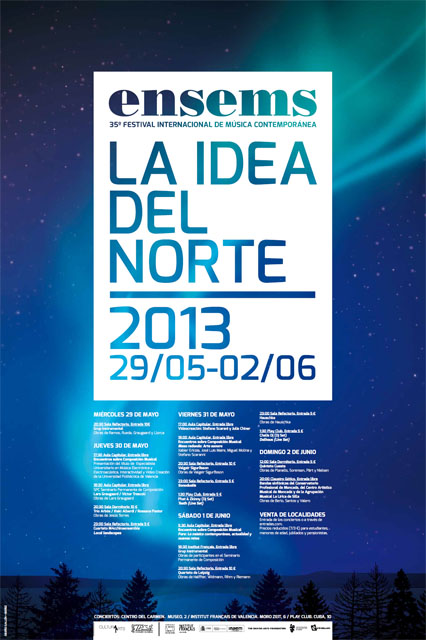
29 de Mayo – 2 de junio de 2013
Distintas localizaciones (véase programa completo ENSEMS 2013)
Los alumnos del MEEVIC podrán asistir de forma gratuita a las clases del Seminario Permanente de Composición con el maestro Lars Graugaard y a todas las actividades y conciertos del 35º Festival internacional de Música Contemporánea ENSEMS (véase programa completo ENSEMS 2013), entre ellos al estreno de la obra para sinfonietta Blind Lemon por el maestro Graugaard.
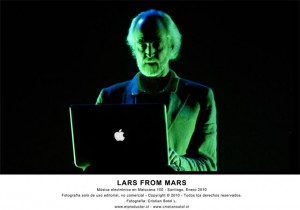
Lars Graugaard
El compositor danés Lars Graugaard obtuvo el título superior de flauta en la Real Academia Danesa de Música y el de doctor en música interactiva e interpretación por la Universidad de Oxford Brookes en el Reino Unido. Como beneficiario de numerosas becas y encargos, su música se interpreta regularmente en Europa, América, Asia y Australia. Actualmente es compositor residente del Grup Instrumental, gracias en parte a una beca de de la Fundación Danesa de las Artes. Desde 2010 ha ocupado un puesto permanente como artista visitante de la Steinhardt School en la Universidad de Nueva York y es director del Festival de Artes Digitales con sede en Copenhague. Compone para todas las combinaciones instrumentales y vocales y tiene en su haber más de ciento ochenta obras. En sus conciertos de los últimos cinco años ha sustituido gradualmente la flauta por el ordenador portátil, explorando la música en tiempo real e interactiva con improvisadores e intérpretes de partituras que se mueven entre la música contemporánea, el jazz y derivados de estilos electrónicos urbanos. Graugaard se encuentra a gusto en salas de conciertos, festivales y clubes; para todos ellos ha desarrollado métodos de composición que tienen en cuenta las estrategias de escucha comunes que son profundas, pero que no tienen necesariamente que ver con el conocimiento estructural explícito.
Blind Lemon
for sinfonietta, composed 2013
[1.1.1.1/1.1.1.0/arpa,piano,1perc/1.1.1.1.1]
perc: angklung, vibraphone (with metal chains), crotales, 1 timpani (28″), 2 sandpaper blocks
The work opens with a dense, imagined texture immediately repeated at a slower pace, which spins off streams of musical materials. These materials are transformed in different combinations throughout the work, and a central idea is that of stretching. As the material is stretched, new details appear at each examination. The details may be more significant in the time or in the timbrical domain, but the consequence is that the work moves forward by moving backwards and inwards. Backwards to the opening texture and inwards into the deeper, hidden layers as the texture is continuously stretched further. The resulting new material is set in horisontal formations of melodic chains or duration patterns, in vertical designs of chords and instrumental colors and in (non)aligned combintations of these. There is an overall development from the gleamy opening texture towards the lock-and-stomp formations towards the end of the work. Between these extremes the work passes through moments of darkness and much smearing in the voice-leading and high-pitched, glistening energies, as well as an instance of immoderate tenderness.
The compositional approach in “Blind Lemon” makes use of the concept of listening modalities. The modes employed here are those of surface listening and structural listening. This approach is in response to our listening capacity which constantly moves between attention points. The situation at hand call for specific types of listening, and disregarding the orientative listening mode (the role of each player as sound-source), the focus is on listening for the sound surface and for the anatomy behind it. The anatomy is not always evident from the information that reaches us through the sound waves (sound surface), even though skill and experience allow experts to deduce the structure from the surface. This implies that while the anatomy may not always be clear, the surface by nature always is. It is commonly thought that a structural listening is deeper and thus a superior form of listening, but it seems that the listening modalities are concurrent, interconnected and heavily interdependent. The structural listening is informed by the surface listening and vice versa, where the surface listening is the one that conveys the composition’s non-verbal ‘meaning’ as an emotional impact. This means that a composition’s structure is not always overtly manifested, whereas the sonic surface as a constant source of meaning always is there.
Both score features and performance features have importance in music representation and are used systematically in the “Blind Lemon” to sustain the expression appropriate to the underlying structure and the overall configuration. The compositional focus hereby utilizes an important feature of listening in general, namely the capacity – even necesity – to switch between listening modes for a more efficient meaning-making.
The title of the work is a reference to the North-American blues performer “Blind” Lemon Jefferson, but most of all to the focus on sound surface with its supporting structures, the latter only visible in the score notation. “Bind Lemon” was commissioned by Joan Cervero and Grup Instrumental de Valencia with support from the Danish Arts Foundation.